
In this guide
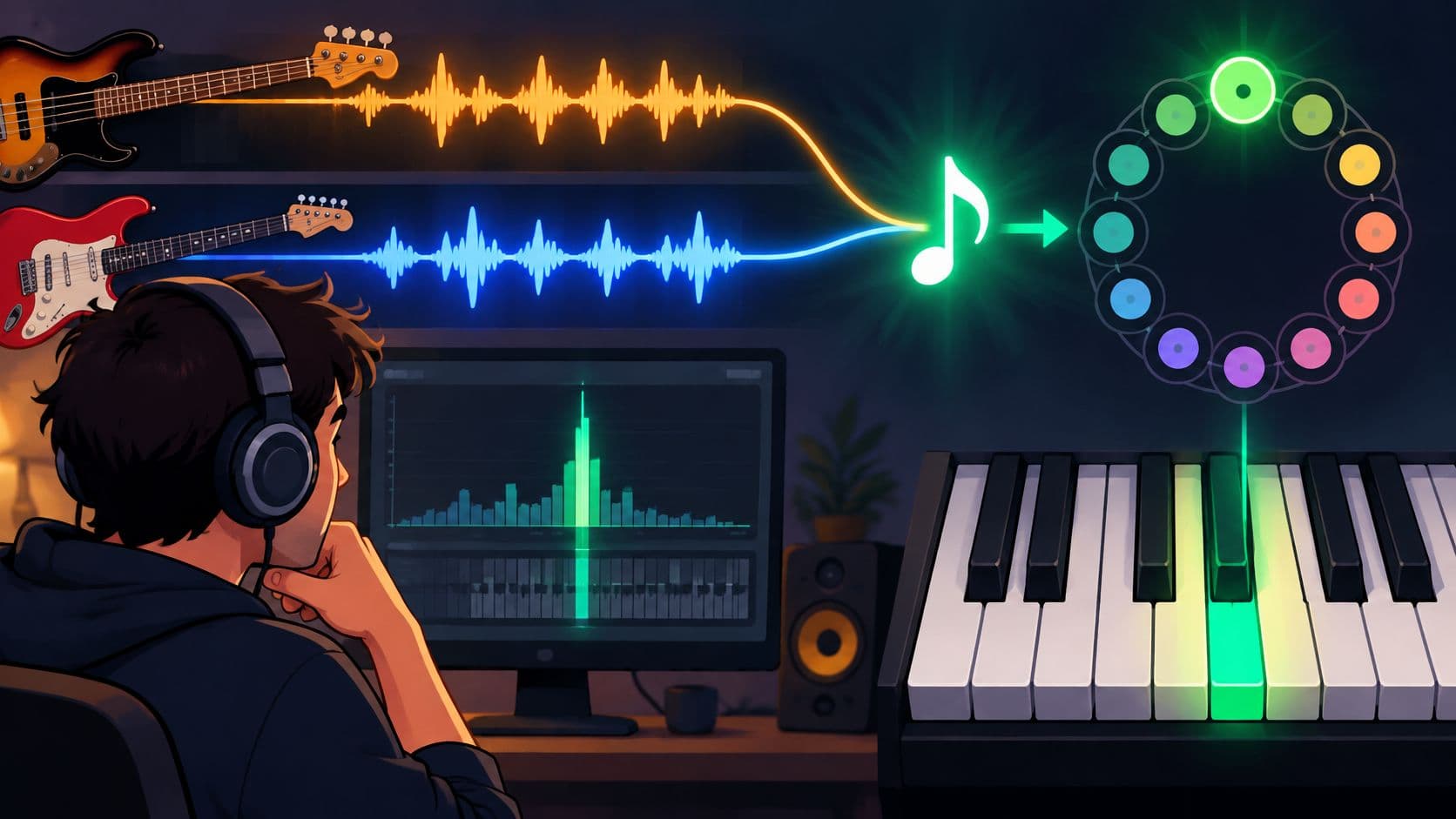
How can a music key identifier return C major when a song seems to settle on A? Both labels can fit the same notes. The harder question is which note sounds like home, and whether the surrounding harmony supports major, minor, or something else.
A useful key label is a testable hypothesis, not a verdict. Software can suggest the answer, but bass movement, melody endings, and chord resolutions provide the listening evidence needed before transposing a vocal or preparing a remix.
How to Identify a Song's Key in Six Steps
A key combines a tonal center, called the tonic, with a mode, commonly major or minor. A music key identifier estimates that pairing from recorded audio.

Build a candidate, then test it
Choose a harmonically complete section. Start with a chorus containing melody, bass, and chords. A percussion-only intro or stripped-down breakdown may not establish a clear tonal center.
Run the analyzer and record alternatives. Note the leading label and closest runner-up, if the software displays one. If it doesn't, keep a neighboring candidate for comparison rather than assuming the displayed answer is certain.
Sound the proposed tonic. Play it on a keyboard or sing it against the recording. Listen beneath the melody to the bass. The tonic should sound like a convincing point of arrival, not merely a note that avoids clashing.
Check the final sustained chord or melody note. Many songs resolve toward the tonic, although some finish deliberately unresolved. A convincing ending strengthens the candidate; an unresolved ending means other evidence matters more.
Challenge the label with its neighbors. For C major, compare A minor and G major. Test which tonic best explains the melody's resting points and the chord movement, rather than which scale can be played over the recording.
Write a usable conclusion. A note such as A minor, chorus; verse ambiguous; moderate confidence tells another musician more than a bare letter name. Confidence should reflect listening evidence, not just an app's display.
The bass and cadence checks matter most because they test harmonic function. A melody can pass through many notes, but a bass-supported resolution helps establish which note acts as home.
Practical rule: A note that fits isn't necessarily the tonic. The stronger candidate explains where the phrase finishes and why it feels settled.
Keep the accuracy claim in perspective
The MARBLE music-understanding benchmark evaluates key detection on GiantSteps electronic-dance recordings using a weighted score that gives partial credit to some related key errors. Its results are specific to that dataset and evaluation protocol; they are not a universal accuracy estimate for every key-finder or song. Treat a software label as a starting hypothesis and compare it with the harmony and cadence.
Dense harmony, detuned instruments, and changing tonal centers can make a label harder to interpret. Compare the suggested key with the relevant passage rather than treating it as certain.
Key Labels That Look Wrong but Are Often Right
Key labels are like addresses on the same street. Several share much of their musical material, so an analyzer can land next door without producing a random answer. The important distinction is whether the disagreement concerns tonic, mode, or spelling.
A major key and its relative minor share their pitch collection, while enharmonic labels can describe equivalent sounding keys with different notation. The Musicca key reference provides the key relationships behind these distinctions. Counting notes alone won't establish which note functions as home.
Neighboring key labels and why software confuses them
| Relationship | Example pair | What the pair shares | Typical confusion |
|---|---|---|---|
| Relative major and minor | C major and A minor | Same seven pitch classes, different tonic | Melody centered on A read as C major |
| Parallel major and minor | C major and C minor | Same tonic, different third, sixth and seventh | Borrowed minor chords in a major song |
| Perfect-fifth neighbor | C major and G major | Six of seven pitch classes | Dominant or subdominant chord read as the tonic |
| Enharmonic equivalent | F-sharp major and G-flat major | Same sound in equal temperament, different spelling | Chart notation differs from the analyzer label |
For C major versus A minor, compare the ending of a complete phrase over each tonic chord. If A minor sounds resolved while C major sounds like an interruption, the minor label has stronger support.
For C major versus C minor, keep C fixed and listen to the chord quality. A borrowed minor chord doesn't automatically make the whole song minor. The surrounding progression may still establish C major clearly.
An F-sharp major versus G-flat major disagreement is different. On an equal-tempered keyboard, the sound won't settle the spelling question. The chart, instrumental parts, and notation convention determine which label communicates more clearly.
Choose the label that serves the musical task
A full song may borrow chords, change key, or establish a different center in its chorus. For transposition and communication with musicians, retain the tonic and mode supported by the relevant chorus and cadence. Match the spelling to the chart when one exists.
A plausible label can still be unhelpful. C leaves major or minor unstated, while a single global label may hide a contrasting bridge. When sections genuinely differ, accurate section notes are better than an artificially tidy answer.
Ear Training Checks for Tonic and Mode
The listening task is to hear the home note that a phrase repeatedly returns to. Loudness, repetition, and emotional character can distract from that task. A prominent note may be a chord tone without being the tonic.
A chorus-length listening drill
Hold a candidate tonic on a keyboard. Hum it beneath the chorus, then sing a major scale beginning and ending on that note. Listen for whether the return feels settled. The exercise tests a candidate; it doesn't assume that the song is major.
Compare the third above the tonic. Play the candidate major and minor chords. Listen for which third matches the stable harmony, not a passing melody note or a momentary borrowed chord.
Follow phrase endings. Check the last sustained sung or played note against the candidate tonic. A phrase ending elsewhere isn't disqualifying, but repeated supported arrivals strengthen the answer.
Try the neighboring home note. Compare the relative key's tonic, then the parallel major or minor chord. Which candidate makes the phrase sound finished rather than suspended?
Bright doesn't necessarily mean major, and sad doesn't necessarily mean minor. Tempo, lyrics, register, and production can change the emotional impression without changing the underlying mode.
The useful question isn't whether a scale sounds pleasant over the song. It's whether its tonic explains the song's resting points.
Separate tuning from key
The ISO tuning standard specifies A4, the A above middle C, at 440 Hz. That reference doesn't determine a song's key, and it doesn't mean every recording follows the same tuning.
Compare an audible sustained A with a reference tone, or use a tuner on a clearly pitched sustained note. Note a consistent sharp or flat offset before treating a neighboring analyzer label as a harmonic disagreement. Live, analog, intentionally detuned, and speed-shifted material deserves particular care.
For a five-minute practice drill, choose three familiar songs. Write down the tonic and mode by ear before opening an analyzer, then compare the answers. For each disagreement, identify whether the difficulty came from tonic, chord quality, tuning, or an unresolved phrase.
Reading Software Key Results and Their Warning Signs
A conventional analyzer folds spectral energy into 12 pitch-class bins, combines that information over time, and compares it with 24 major and minor profiles, as described in this ISMIR key-estimation paper. It estimates the dominant global tonal center rather than reading a definitive metadata field.
That distinction explains plausible mistakes. A sustained pad can dominate the pitch profile, while a forceful bass line can outweigh quieter chord tones. The best-matching template may describe the most prominent sound rather than the most convincing musical center.
Analyzer results, likely causes and the check to run next
| Observed result | Likely cause | Next check |
|---|---|---|
| Intro gives a different key from the chorus | Drum-heavy or pad-led intro skews the pitch profile | Re-run on the first melodic bar and on the chorus |
| Label changes between runs or tools | Ambiguous harmony or modal material | Compare runner-up labels and listen to the final cadence |
| Label sits a fraction off what the bass suggests | Tuning drift, detuned or speed-shifted audio | Check against a 440 Hz tone and sustained notes |
| Confident label on an isolated vocal | Separation removed bass and chord tones | Compare the isolated result with the full mix |
| Global key differs from the final section | Key change or modulation | Report each section with its own label |
A fractional pitch offset needs careful interpretation: key labels are discrete, but recording pitch can fall between reference notes. An analyzer displaying a neighboring key may be responding to tuning rather than discovering a different harmonic structure.
A high confidence display also has limited scope. It can mean that one profile fits the analyzed audio much better than the alternatives. It doesn't prove that the input contains enough musical context to identify the intended key.
Use disagreements as diagnostic evidence
A reliable troubleshooting order keeps the comparison controlled:
- Re-analyze defined passages. Use the first melodic bar and a complete chorus rather than different arbitrary excerpts.
- Record the alternatives. Save the runner-up label for each run when available. Otherwise, mark it as unavailable and test neighboring candidates manually.
- Inspect the musical resolution. Audition the ending and sustained bass notes with the proposed tonic.
- Rule out tuning mismatch. Check a sustained reference pitch before blaming the algorithm.
A close relative, parallel, or fifth-related runner-up signals a specific question to investigate, not proof of ambiguity by itself. If C major and A minor compete, test the home note; if C major and C minor compete, inspect chord quality.
One short excerpt isn't enough evidence for a project note. A chorus and ending check provide a more defensible minimum before the label informs an edit.
Identifying Keys from Isolated Stems in Saturalabs
An isolated bass or keyboard part can make a buried tonal clue easier to hear. It can also lack the surrounding harmony needed to interpret that clue. Isolation is a listening aid, not automatic key confirmation.
Saturalabs provides text-guided audio/video isolation, not music generation or a general video editor. Each separation pass targets one described audible source; it doesn't split every instrument at once.
Extract evidence without losing the reference
Upload the recording and preserve the original. Supported uploads are MP3, WAV, MP4, and MOV, up to 50 MiB (52.43 MB). Keep the original available for synchronized comparison.
Name one audible source per pass. Use a focused prompt such as Isolate electric piano or bass guitar. Run bass and keyboard requests separately. The audio-isolation prompt guide explains wording choices without turning the prompt into a list of instruments.
Choose Isolated sound for the target. Start by auditioning the chorus. Background audio is the remaining recording with the named target removed, not another name for the isolated part.
Compare matching timestamps. Switch between the extracted part and original during difficult passages. Listen for missing chords, smeared note attacks, warbling, or notes that vanish under overlapping sounds.
Analyze the clearest isolated passage, then the full mix. Write down both results. Agreement is useful supporting evidence, while disagreement identifies a passage that needs closer listening.
Test the proposed tonic musically. Compare it with the extracted bass and the final cadence in the original. Keep the stem label provisional until the complete recording supports that interpretation.
For practical extraction details, the guide to isolating an instrument from a song supports this auditioning workflow. The stems-versus-audio-isolation comparison helps distinguish a requested-source extraction from a set of instrument stems.
Listen for evidence that separation removed
Separation can thin a chord, weaken a bass fundamental, or retain only part of a sustained note. Source-separation assessment distinguishes interference, distortion, and introduced artifacts, as explained in this audio-source-separation review. A louder target isn't necessarily a more faithful target.
Reference check: A clean-sounding isolated note can still be misleading when the chord that explains it is missing.
Output selection also matters outside instrument checks. For karaoke, target vocals and audition Background audio; for speech, target spoken voice and audition Isolated sound.
Avoid unnecessary format conversion during preparation. MP3 conversion with the local converter is lossy, doesn't start an AI job, and doesn't use credits. Converting a recording won't restore harmonic detail already missing from its source.
Handling Ambiguous, Modal and Modulating Songs
Sometimes a single global key is the wrong answer. A clear tonic and consistent major/minor harmony support a label such as D minor. A clear D center with a characteristic modal scale may instead call for D Dorian, while unsettled harmony may justify ambiguous.
Key-estimation annotations themselves can contain errors, a problem examined in this study of annotation-error detection. A published or automated label therefore shouldn't override contradictory musical evidence.
Recording types that need extra key verification
| Recording type | Why the label is unreliable | How to verify |
|---|---|---|
| Loops and sample-based beats | Short repeated fragments may not establish a full tonal center | Label the loop and note that the full track may differ |
| Live performances | Pitch drift and tuning changes across the set | Check sustained notes against a tuner before labeling |
| Bass-heavy mixes | Low register dominates the pitch profile | Compare the bass line with the melody's landing notes |
| Modal tracks | The tonic is clear but major or minor does not fit | Report the mode explicitly, for example D Dorian |
| Atonal or sparse sections | No reliable tonal center | Label as ambiguous rather than forcing a key |
| Mashups | Several keys combined in one file | Report one label per source and per section |
| Pitch-shifted or time-stretched audio | Pitch change or imperfect pitch preservation can alter tuning | Compare against the original and a 440 Hz tone before labeling |
Time stretching needs a distinction: changing duration doesn't necessarily change pitch. Check the processed recording rather than assuming every tempo adjustment has transposed it.
Report what the evidence actually supports
A modal label needs more than an analyzer's failure to choose major or minor. For D Dorian, listen for D as home and the characteristic raised sixth relative to D natural minor. If those features aren't clear, an uncertain label is more honest than a precise-looking modal guess.
When sections differ, write something concrete: Intro: F minor; chorus: A-flat major; bridge ambiguous. Mashups need labels for their constituent sources and sections, while loop notes should make clear that the surrounding track hasn't been assessed.
For remix preparation, section-specific notes help prevent an apparently compatible excerpt from clashing later. The guide to creating a remix provides the broader production context.
For an isolated bass or vocals passage, audition the extraction against the original at matching timestamps before labeling it. The reporting rule stays simple: record the tonic, mode, section, and confidence, with a brief reason whenever uncertainty could affect the next edit.
Confirm the Key Before You Transpose or Export
When the chorus tonic, bass movement, and final cadence agree, the label has useful support for transposition or remixing. When they disagree, retain section-level notes and investigate before export. A convenient global label isn't worth an avoidable harmony mistake.
Keep a final project checklist
- Confirm the tonic. Check the chorus, bass line, and final cadence.
- Include the mode. Write A minor, not just A.
- Verify the source material. Compare isolated and original audio at every passage scheduled for alteration.
- Mark exceptions. Give contrasting sections their own labels and save the notes with the project.
The guide to changing the key of a song addresses the next production decision. After processing, audition the changed passages again rather than assuming the original analysis guarantees a successful result.
Before downloading separated audio, check the displayed credit cost. Downloads require an account and sufficient credits. Rights to the recording and its intended use remain the editor's responsibility.
Saturalabs offers text-guided isolation of a named audible source, which can help reveal bass movement or keyboard harmony during a key check. Visit Saturalabs, name one source, select Isolated sound, and compare the result with the original before committing to a key label.